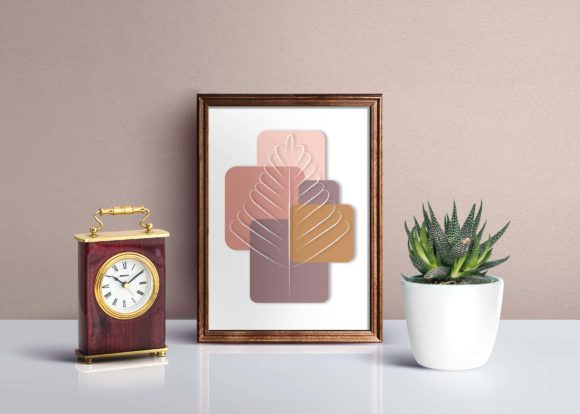
The Intersection of Precision and Nature: Understanding Geometric Floral Art
Artistic expression often finds its most compelling forms at the confluence of contrasting ideas. One such union is the marriage of the organic, flowing beauty of botanical forms with the rigid, structured logic of mathematics and geometry. This fusion creates a distinct visual language known broadly as geometric floral art. It is a style that captures the essence of flowers, leaves, and vines through circles, triangles, polygons, and lines, resulting in designs that feel both timeless and modern. This approach to design strips away the unpredictable softness of natural forms to reveal an underlying, often hidden, architecture.
A Design Philosophy Rooted in Structure
At its core, geometric floral art is not merely about drawing flowers with straight edges. It represents a design philosophy. Artists and designers working in this style analyze the natural subject—a rose, a fern, a peony—and deconstruct its shapes into fundamental geometric components. A petal might be rendered as a series of intersecting arcs, a stem as a clean, minimalist line, and a leaf cluster as a pattern of repeated triangles. This process creates artwork that is highly scalable, reproducible, and adaptable. The precision involved makes it particularly suitable for digital creation, where vectors and exact measurements are paramount. This inherent suitability for digital formats is a key reason why such art is frequently offered as downloadable, printable content.
The Practical Advantages of Printable Geometric Art
Owning or displaying art no longer necessitates a physical visit to a gallery or a lengthy commissioning process. The digital distribution of designs like geometric floral patterns has revolutionized personal and professional decoration. When a design is created with geometric precision, its integrity holds perfectly at any scale. This means a user can acquire a single digital file and have the flexibility to produce a piece suited to a specific space—from a modest desktop picture to a large statement wall piece. The phrase "just download, print and hang" encapsulates this streamlined process. It shifts the art acquisition model from one of procurement and shipping to one of instant access and local production.
This model offers significant advantages. Cost is often reduced, as there are no physical production or international shipping fees for the final product. The consumer pays for the design intellectual property and the local printing, which can be done at home or through a professional print service. Speed is another benefit; the entire process from selection to display can be completed in a matter of hours. Furthermore, control is enhanced. You are not limited to the single size an artist might choose to physically produce; you select the exact dimensions that fit your frame, your wall, and your vision.
Understanding Print Files and Size Ratios
To achieve the "print and hang" ideal successfully, understanding the provided digital files is crucial. High-quality geometric floral art downloads typically include multiple file formats tailored for different output needs. JPG files in high resolution at 300 dpi ensure detailed, pixel-perfect reproduction for standard printing. Scalable PDFs, often vector-based, allow for resizing without any loss of clarity or sharpness—a critical feature for geometric designs where clean lines are essential.
The inclusion of multiple files with specific aspect ratios, as detailed in common offerings, directly addresses the versatility promise. Each ratio caters to standard frame sizes and popular display formats.
- A file with a 2:3 ratio supports a range from intimate prints like 4x6 inches to substantial posters at 16x24 inches. This ratio is extremely common and versatile.
- An 3:4 ratio file is ideal for prints like 12x16 inches or 9x12 inches, offering a slightly wider appearance.
- The 4:5 ratio is perfect for classic sizes such as 8x10 inches or 16x20 inches, a favorite for portrait-oriented displays.
- International ISO paper sizes, like the A-series (A2, A3, A4), are based on a consistent aspect ratio and are standard in many parts of the world, particularly for office or home decor where framing might not be the immediate goal.
By providing these distinct ratio files, the designer ensures that the geometric floral artwork will fit pre-existing frames or standard mounting options without awkward cropping or distortion, preserving the intended balance of the composition.
Applications Across Audiences and Environments
The utility of downloadable geometric floral art spans the intended broad audience. For professionals in interior design or office management, these prints offer a quick, cost-effective way to inject branded or aesthetically cohesive art into a space. A geometric floral pattern can soften a modern corporate environment without appearing frilly or informal. Educators and researchers might use such prints in libraries, study areas, or laboratories to create a visually stimulating yet orderly atmosphere. The clarity of geometric art can aid focus.
For hobbyists and home consumers, the appeal is in the personalization and ease. You can experiment with different sizes in different rooms. A large geometric rose print might dominate a living room, while a small, intricate geometric fern pattern could adorn a bathroom wall. Business owners, particularly in retail, cafes, or clinics, can use locally printed geometric floral art to define their space's character without a major art investment. The style often conveys a sense of clean, contemporary sophistication.
Key Considerations for Printing and Display
While the process is straightforward, optimal results depend on attention to a few details. The included instructions and recommendations file is therefore a vital component. First, the choice of printer and paper is paramount. For larger sizes, using a professional print service ensures color accuracy and the use of archival papers or canvases. For home printing, selecting the correct paper type—matte, glossy, heavyweight—will dramatically affect the final look. Geometric floral art with sharp lines and solid color fields often looks exceptional on matte or semi-gloss papers that reduce glare.
Second, understanding resolution is key. The 300 dpi specification means the image has 300 dots (pixels) per inch. Printing a 16x24 inch image from a file sized for that output at 300 dpi will result in crisp detail. Attempting to print that same file at 32x48 inches would effectively halve the resolution to 150 dpi, potentially leading to a blurry or pixelated outcome. Hence, using the file specifically designed for your desired print size, as grouped by ratio, guarantees the resolution is optimized for that output.
Finally, framing or mounting choices should complement the art style. Geometric floral designs, being structured, often pair well with simple, clean-lined frames. Floating frames or gallery-style mounts can enhance the modern feel. The art itself, being a blend of nature and geometry, offers enough visual interest that overly ornate framing might distract from its precise beauty.
The Broader Relevance in Design Trends
Geometric floral art sits within larger movements in contemporary design. There is a growing appreciation for art that bridges digital and physical realms. It also aligns with trends favoring customization and immediate gratification. Furthermore, in an era where sustainability is considered, digital distribution reduces carbon footprint associated with logistics. The style’s inherent order and pattern can also be seen as a visual response to a complex world, offering a sense of harmony and predictability drawn from the natural chaos of flora.
This form of art is not static. Artists continue to explore it, merging it with other styles, incorporating kinetic elements, or using it as base patterns for textile design, wallpaper, and digital backgrounds. The downloadable, printable model for geometric floral art thus serves not only a practical distribution need but also participates in an evolving dialogue about how we create, share, and experience visual culture today.
Ultimately, the appeal of geometric floral art lies in its dual nature. It offers the emotional connection and beauty we associate with flowers and plants, yet presents it through a lens of logic, stability, and clarity. This makes it uniquely adaptable and universally appreciable. When combined with the practical model of instant digital download and local printing, it becomes an accessible tool for personal expression and environmental enhancement. The process truly empowers the user: you select the design, you choose the size, you control the medium, and within a short time, you possess a piece of art that is both a product of nature's inspiration and human precision.